Techealthiest | The Technology of Mental Health
  • Mental Change Tech
    • Happiness
      • Habit Shifter
      • Smartest Future
    • Stress
      • Human-Phone Bond
  • Parent Thing
  • Social Media Lama
    • Love Optimizer
    • App Dating
    • Healthy Selfie
    • Healthify Facebook
    • Enlightened Upgrading
  • Narcissist Mgmt
  • Phone Love
  • Covid
    • The Bright Side
  • About
    • About Techealthiest
    • About Dr. Greg
    • The Techealthiest Mission
    • Privacy Policy
    • Terms of Use
    • Contact
Welcome to the digital makeover of Techealthiest!
Monday, March 16, 2026
Techealthiest | The Technology of Mental Health
  • Mental Change Tech
    • Happiness
      • Habit Shifter
      • Smartest Future
    • Stress
      • Human-Phone Bond
  • Parent Thing
  • Social Media Lama
    • Love Optimizer
    • App Dating
    • Healthy Selfie
    • Healthify Facebook
    • Enlightened Upgrading
  • Narcissist Mgmt
  • Phone Love
  • Covid
    • The Bright Side
  • About
    • About Techealthiest
    • About Dr. Greg
    • The Techealthiest Mission
    • Privacy Policy
    • Terms of Use
    • Contact
Techealthiest | The Technology of Mental Health
  • Mental Change Tech
    • Happiness
      • Habit Shifter
      • Smartest Future
    • Stress
      • Human-Phone Bond
  • Parent Thing
  • Social Media Lama
    • Love Optimizer
    • App Dating
    • Healthy Selfie
    • Healthify Facebook
    • Enlightened Upgrading
  • Narcissist Mgmt
  • Phone Love
  • Covid
    • The Bright Side
  • About
    • About Techealthiest
    • About Dr. Greg
    • The Techealthiest Mission
    • Privacy Policy
    • Terms of Use
    • Contact
Copyright 2021 - All Right Reserved
happiness, sunset, perspective
Happiness

Look Here After Your Phone Screen for a Moment of Health and Happiness

by Greg Kushnick, Psy.D. February 21, 2019
written by Greg Kushnick, Psy.D.

(Updated on February 21, 2019)

Yes, as the picture above shows, if you can find the horizon, it’s a gift waiting to be claimed.

Horizons are the antidote for a phone screen overdose. Look to the horizon when you lift your head up.

Horizons are healthy. Basking in a gorgeous, pastel sunset on the horizon is even healthier, but any horizon will do the trick.

The horizon centers you and gives you an opportunity to reset.

If you live a myopic lifestyle (you only attend to what’s right in front of you), then horizons are gold. Looking far into the distance can grant you the perspective you might have been longing for.

Perhaps you’ve been too caught up in a painful thought. Let the horizon show you the big picture.

Horizons also have the ability to remind us that visual stimulation exists far beyond your phone screen. Let your eyes feast on what’s beyond your immediate reach.

Enter the beauty of the horizon even if you are gazing between tall buildings on either side of the street. Celebrate the horizon even if it’s a wintery mess, or it’s ordinary or grey or all you can see is just a bunch of houses in the distance.

Challenge yourself to find the beauty in any horizon, even if it’s momentarily forced.

It will help to keep you mentally upright and not seasick in an ocean of responsibilities.

Let the horizon come to symbolize happiness by looking ahead in the distance and saying, “Happy!” out loud. Make a habit of pairing the act of looking as far as you can see with arriving at a healthy perspective that properly frames the troubles of your day.

Once you’ve taken in the horizon and you feel a drop happier and more centered, then go back to your phone.


February 21, 2019 0 comments
0 FacebookTwitterPinterestEmail
screen, attention, phone, children, parent
Digital Lifestyle GuideHappinessParenting

What Do Screens and an Insatiable Hunger for Attention Have in Common?

by Greg Kushnick, Psy.D. February 8, 2019
written by Greg Kushnick, Psy.D.

How to Avoid Raising an Attention-Hungry Child in the Digital Age

What happens when a toddler’s basic need for love and attention is forced to compete, day in and day out, with her parents’ screens?

This topic currently weighs heavily on my shoulders and holds on to my conscience as I try to figure out the techealthiest ways to share my world with a two-year-old toddler.

Yesterday, I was smacked in the head with thought that I’m in danger of raising a daughter with a lifelong, vicious hunger for attention.

I was re-experiencing a nagging memory from last weekend of us sitting together in our parked car. My daughter’s favorite CD (and strangely enjoyable for adults…even on repeat), Preschool of Rock, was playing as my eyes wandered onto my phone to check my email for no good reason. I looked up at my daughter after 30 seconds of pointless phone use and she locked eyes with me and yelled, “Hiiii!” as though we were just reunited after three months apart. She danced in her seat to the music now that she had my full attention back, and she expected me to follow her lead.

She had been waiting for me to make eye contact with her, but I chose my screen over her gorgeous blue eyes.

I was disturbed by my neglect and the enthusiasm behind her 5 -second “Hi.” She was so excited to connect with me, so hungry for togetherness. Thirty seconds before my screen scan, we were merrily bopping to the music, but my auto-pilot interrupted this precious moment.

Nothing emergent necessitated my need to look down at my phone. It was purely a screen-checking habit getting the best of me (or should I say taking the best from me?). Let’s just say that I consider myself an attentive dad, but just like everyone else with a smartphone, I often don’t distinguish between the good and bad times for mindless phone checking.

This simple experience is something that probably repeats dozens of times a day for my daughter, and probably much more on the weekends.

What happens to a child who grows up with tens of thousands of memories of her parents interrupting conversations, tender moments, meals, walks, and couch time to check a screen?

My educated guess is that children develop attention-seeking behaviors in response to competing with screens. In toddlerhood, they tantrum or show mild protest to get their parents’ attention back. In teenagehood and adulthood, the need for attention manifests in more complex and self-destructive ways.

The quality of attention a parent pays to her child while they communicate with one another, as well as the frequency and predictability of disruptions in communication, probably determines how psychologically damaging the incessant checking of screens is to a growing child.

So what do I recommend to avoid raising an attention-hungry child?

Here are 7 screen-related suggestions equivalent to making a greater investment in the mental health of your children:

1) Most importantly, when you are around your children, commit to checking your phone or other screen less often. Just start with a simple declaration that you’re committed to giving your children a higher grade of attention. Say it out loud so someone can hear you. Hear your own word to yourself so your integrity matters more.

2) Think of the one or two places where you are most likely to commit the worst kid neglect due to screens. Target those contexts first. Even a mild reduction in screen checking will make a difference to your child.

3) If you do need to check your screen, do it in a predictable manner. Tell your child how long you plan to look at your screen and then have the integrity to give them your undivided attention once the time expires. If you must keep checking your phone, offer a warning that your attention will be temporarily suspended.

4) Never use screen checking as an attention-withdrawing punishment. That creates a painful association between your technology and neglect.

5) Just because there isn’t, to my knowledge, a solid base of empirical evidence linking screen use to attention-hungry children, doesn’t mean you should ignore this potentially painful and avoidable problem you may be creating for your child. Take a step back and observe the love triangle between you, your children and your screens. Don’t be surprised if you discover your own sobering evidence that your children crave your attention in a disturbing and unhealthy way as a result of the competition you’ve created.

6) Ask yourself how good the QUALITY of your quality time is with your children. If you’re checking your phone every few minutes when you’re face-to-face with your kids, then just know that you are teaching them that they have to go to extreme measures to gain people’s attention. (Click here for more powerful tips for improving the quality of your quality time in your important relationships.)

7) The hardest thing to do for most people is to simply turn off their phone or leave it in another location where it can’t be easily accessed. I recommend creating daily rituals with your kids that don’t involve a screen. You’ll see how much you and your children will look forward to this time. For example, when it’s freezing outside and we’re stuck indoors, my daughter and I will run around in the lobby of our building like wild animals. My phone is off during this time. (Click here for more on the signs that your phone dependency has gotten out of hand.)

Can you place yourself in the shoes of a person who has grown up with a memory of 100,000+ moments of wanting her parents’ attention, but had to wait for them to finish checking their messages or social media feed?

That sounds painful to me when I think of my child having to endure countless, unnecessary moments of being chosen second to a screen. I’ve already tried these recommendations out on myself in the process of writing this post and it feels great to give my daughter a less interrupted version of me.

Some parting words…

High quality attention is hard to find these days, but easy to give if it really matters to you.

Don’t teach your children that they only deserve part of your attention, or that life is about competing with an Iphone or an android for parental love.

Your children will perpetuate the same lack of attention to the people they love if it’s repeatedly modeled for them by their parents.

I leave you with this…Screens are memory killers. In order to build powerful and comforting memories of parent-child bonding that you and your kids will fondly recall for years and years, there can’t be a personal screen invading that moment. You need undivided attention to create a lasting memory.

This post presents a difficult challenge, but it’s as important as anything you’re trying to teach your children.

Just remember…

[bctt tweet=”A moment of choosing your screen over your child is a memory lost.”]

February 8, 2019 0 comments
0 FacebookTwitterPinterestEmail
insomnia, can't sleep, lack of sleep, sleeping, trouble sleeping, sleeplessness, I can't sleep, tips for sleep, sleep visualizations, fall asleep
Sleep

Can’t Sleep? Try These Unique Insomnia Tips

by Greg Kushnick, Psy.D. February 5, 2019
written by Greg Kushnick, Psy.D.

If you’re having trouble sleeping, I’d like to offer you some unique sleep tips you won’t find in many places.

These tips are especially valuable if you’ve tried the standard recommendations for insomnia and you still can’t sleep.

Keep in mind the following information about my tips for falling asleep:

  • They are best attempted by trial and error.
  • They can be used at the start of your night’s sleep or to help you go back to sleep.
  • They may be especially helpful if your sleeplessness is influenced by anxiety, troubling thoughts or a general difficulty focusing on a calming thought or image with your head already on the pillow.
  • They aren’t scientifically proven to work, but I’ve observed them as being helpful for many of my patients who’ve struggled with mild to moderate insomnia.
  • They’re oriented toward the strategy of using simple visualizations to relax your mind and take your attention away from bad thoughts or anxiety about what tomorrow will be like if tonight there’s a lack of sleep.

So let’s put your sleeplessness to rest and get you to count z’s like a champion.

Try These 5 Insomnia Tips If You…Just…Can’t…Sleep

1. Picture a place in the world that fascinates you and fly over it like Superman (or Supergirl.)

Use your mind’s eye to fly like Superman over any location in the world. Witness people of another culture doing whatever you think they would do during a normal day or whatever comes to mind. You are totally safe from above. Be fascinated by your power to fly. Observe a familiar place or an exotic location. Just make sure you choose a comforting scene associated with curiosity, simple pleasures or calm. Do you choose to see trees? Towns? Houses? Mountains? Kids playing? Rivers? Stay away from places that remind you of pain or conflict. Keep visualizing until you tire out. Allow yourself to see boring sites as well or witness the everyday humdrum of life. It just might help you to drift off into sleep land.

2. Picture yourself interacting with your favorite characters in a movie, book or TV show. 

That’s right. Go ahead and allow yourself to live along side of the larger-than-life characters. You’ve probably become so familiar with them that it’s like visiting old friends, which can have a calming effect. Make up a story in mind and interact with these characters. Act like the scenery is real life. Believe it or not, Game of Thrones characters work for me. Maybe it’s the amazing scenery and the depth of the characters who I’ve grown to care for.

3. Count by 7’s, 8’s, 9’s or any number whose multiples you haven’t memorized.

This exercise is aimed at tiring out your mind. Initially, it might wake you up a bit as you access your brainpower to figure out the multiples. Count to 200 or some number that challenges your mind. Repeat if you want. The goal here is really to take your mind off of anything troubling and make you focus on a menial and boring task. Consider switching to one of the other visual tips once you feel this is tiring you.

4. Pretend to snore.

Please apologize in advance to anyone who may be occupying the bed with you. Make a light snoring noise as you pretend you’re sleeping. This will promote deep breathing. Focus on taking giant breaths, but don’t make the breaths unnatural. Just imagine how you’d be breathing if you were really sleeping. Do this for as long as it takes to reach a greater level of relaxation. If you’re saying to yourself, “I can’t sleep,” trick yourself into thinking the opposite by pretending to be sleepy. Try saying, “Wow, I’m getting so sleepy.” Keep imagining yourself falling asleep. Then snore away.

5. Get out of bed and make a to-do list on paper if you can’t stop thinking about tomorrow’s tasks. 

Divide a piece of paper in half (not your phone because that will lead to more time awake) and make two lists: one of urgent tasks and another of important tasks. Number what you believe needs to be done first, second, third, fourth, etc. Designate an easily achievable task as #1 to get your productivity engine up and running. Then move to the more challenging tasks. An optional second step is to visualize yourself doing each of these tasks successfully. Then get back in bed and don’t be surprised if you find yourself ready to fall asleep. Why? Preparing a to-do will make you feel like life is more in your control and you won’t have to worry as much about remembering all that needs to be done tomorrow.

Note: These recommendations are meant to teach you how to fall asleep if you sleeping problems are mild to moderate. They are not meant for battling serious and chronic insomnia. If you experience chronic insomnia, please consider discussing it with your primary care doctor or a sleep specialist who can conduct a formal assessment and make recommendations to eliminate your sleeping problems.

You want also might want to rule out sleep apnea, depression and other conditions that require further attention.

Please comment below and feel free to let me know how you used these tips to fall asleep.

Good luck and sleep tight!

Resources on Sleep

Best Foods for Sleep

Simple Tips for Sleep

Sleep Disorders

Sleep Problems in Children

Understanding Sleep

February 5, 2019 0 comments
0 FacebookTwitterPinterestEmail
2019, Happy New Year, Resolutions, Goals for 2019, Techealthiest goals, dr. greg Kushnick, advice for the new year
Habit ShifterMental Change Tech

The Secret to Success with Your New Year’s Resolutions

by Greg Kushnick, Psy.D. January 2, 2019
written by Greg Kushnick, Psy.D.

Happy New Year! As we enter 2019, many of us feel inspired to get started with one or more resolution we’ve struggled with in the past.

I’m here to tell you what will make your New Year’s resolutions stick.

After helping thousands of clients fulfill their treatment goals (and New Year’s resolutions), I’ve learned that the most important ingredient for a successful New Year’s initiative is the following:

Create a system of social accountability so that you’re not alone in meeting a measurable goal.

What Is Social Accountability?

You create social accountability when you enlist your friend, relative or colleague in helping you reach for your goals.

Don’t underestimate the power of social accountability to bolster your resolutions. I’ve seen it work countless times.

You and your “resolution partner” come up with a very specific, written plan for what you want to accomplish.

You both become each other’s coach.

The same goals for both of you are not needed. Your job is to make sure you know exactly how your partner is going to meet his or her goals and vice versa.

Answer the following questions together:

  • How often you will check in with each other about your resolutions. Will it be the same time weekly? Daily? Biweekly?
  • How will you communicate during these checkins? By phone? In person? Via Skype or FaceTime?

I would say that texting as method of checking in with one another does not evoke enough social accountability. Use messaging as a last resort.

Why Does Social Accountability Work?

It works because you feel pressure to satisfy your partner’s expectations. For many people, social accountability also brings out a competitive drive.

The combination of the pressure you put on yourself (independent of your partner’s influence) and social accountability predicts the best outcomes with your New Year’s resolutions.

Should It Be Made into a Competition?

I’m all for New Year’s resolutions being made into social competitions. This usually requires that you have similar resolutions.

The most common resolutions I’ve seen benefit from being transformed into competitions deal with weight loss, but it can work for any objective.

You can have a prize at the end to add motivation to compete and reach your personal goals.

Good luck with your New Years resolutions! I wish you all the best!

Dr. Greg

Resource: Here are some wonderful ideas for resolutions related to improving your health.

January 2, 2019 0 comments
0 FacebookTwitterPinterestEmail
Love and RelationshipsOnline Dating Strategy

These Two Love Quotes Hold the Key to Relationship Success

by Greg Kushnick, Psy.D. January 1, 2019
written by Greg Kushnick, Psy.D.

In the spirit of Valentine’s Day, I’d like to offer you some relationship advice in the form of two love quotes and the priceless lessons they teach us.

I strive to live by these quotes. Given their power to enhance romantic love, I feel inspired to share them with you.

Choose to apply this advice to your relationship and you just might find yourself feeling an elevated sense of love and connection toward your significant other.

2 Superb Love Quotes That Contain Phenomenal Relationship Advice

The following love quotes can add something wonderful to your relationship if put them into action: 

Love Quote #1

Love is when the other person’s happiness is more important than your own. -H. Jackson Brown, Jr.

When two people are wholeheartedly committed to each other’s happiness both in language and in action, the sky is the limit for how high the love can take them. It’s a win-win situation.

And what an amazing feeling it is to sense this extreme commitment from your partner. This mentality doesn’t come naturally for a lot of people. In fact, once infatuation begins to wear off, the motivation to hyper-invest in your partner’s needs is at risk of decreasing. Therefore, this mindset must be put into practice early and often in order to eventually make it automatic.

It will come naturally when it’s cultivated over time.

Make decisions based on your partner’s happiness, even if it feels like you’re taking one for the team.

Recognize that your happiness depends on your significant other feeling this type of love and commitment from you.

Love Quote #2

Immature love says: ‘I love you because I need you.’ Mature love says ‘I need you because I love you.’ -Erich Fromm

Don’t mistake an unhealthy state of need for true love.

How do you distinguish healthy from unhealthy relationship needs?

We all have unfulfilled childhood needs that either subtly or not-so-subtly impact our romantic love. There’s no way around this.

It’s becomes a relationship problem when these needs dominate. Two tell-tale signs of unhealthy needs wreaking havoc on a relationship are:

  1. When one partner’s needs cannot be fulfilled no matter how much “love” is given. It’s a black hole that can’t be filled for more than a few hours
  2. When someone is placed in a catch-22 as a result of his or her partner’s needs. There’s a sense of being “stuck” or “screwed” no matter how you satisfy your partner’s underdeveloped psychological needs. (Neither of two conflicting options lead to a positive outcome.)

Mature love transcends unmet needs.

A mature form of love sounds and feels something like this:

  • You love because you experience an enduring respect for him or her (AND at least to some extent for yourself).
  • You adore him or her beyond what infatuation leads you to feel.
  • You’re willing lose the boundary between you and your mate because your mate has made it safe to do so.
  • You don’t pay a price for allowing your love to make you vulnerable.
  • You feel spiritually complete with him or her as your partner for life.
  • You want to be a better person because your partner inspires you.
  • You love him or her because of the person that he or she is, not what he does for you that numbs past emotional pain.
  • You need because your partner becomes your lifeline and you can’t imagine life—let alone a day—without him or her.

The idea of “needing” your significant other is a tricky one. When the love remains strong over the years, there IS a healthy sense of need that develops. It’s as though your lives become inextricably intertwined and you wouldn’t have it any other way.

On the unhealthy side of need, there is a state of dependency in which one partner gains from the other partner’s weaknesses.

For example, Jane is afraid to be alone. She fears that her husband Jim will abandon her. Jim takes advantage of her dependent state of need by mistreating her, focusing too much on his own needs and failing to invest properly in her happiness (see the previous love quote).

Strive to develop your love into a mature love by committing to your own personal growth AND to your partner’s personal growth (again referring back to love quote #1).

Only good things for the relationship will grow out of this commitment.

Click here for more on the importance of committing to personal growth.

Sources:

More Quotes on Love

More on the Catch 22 Scenario in Relationships

January 1, 2019 0 comments
0 FacebookTwitterPinterestEmail
Healthy Narcissism

How to Use Narcissism for Success

by Dr. Greg February 26, 2018
written by Dr. Greg


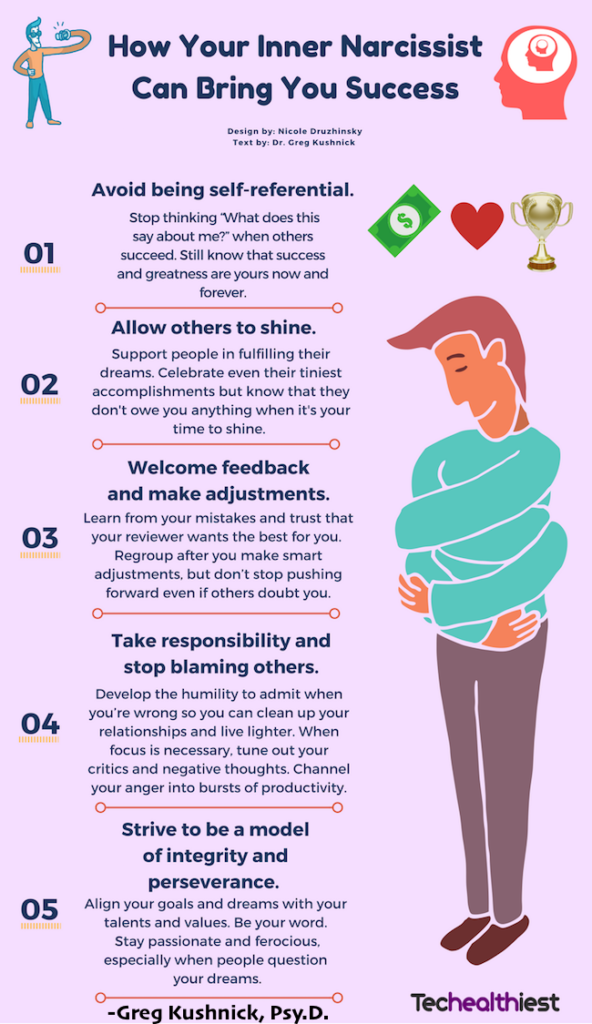
This infographic is designed to speak to the inner narcissist in you so that you can achieve success with your goals. Essentially, this visual is promoting healthy narcissism, which refers to the ability to amplify the importance of your own dreams, ideas and opinions when it is strategically needed. This enhanced self-focus is sometimes necessary to push past obstacles such as outside criticism or disappointment.



If you get thrown off by people who oppose a goal of yours and you tend to blame others rather than actually sit and think about what’s been said, then you would be loosely considered an “unhealthy narcissist.”

Use this visual as a guide to inspire you to become a healthy narcissist.

For more on healthy narcissism, take a look at Techealthiest’s series on the topic.


February 26, 2018 0 comments
0 FacebookTwitterPinterestEmail
overcome loneliness, lonely, advice for valentines, relationship advice, digital happiness, self-care on valentines day
Digital Stress ManagementLove OptimizerOnline Dating Strategy

10 Digital Strategies for Overcoming Loneliness on Valentine’s Day

by Greg Kushnick, Psy.D. February 11, 2018
written by Greg Kushnick, Psy.D.

This post is dedicated to helping you turn your loneliness into aloneness on Valentine’s Day.

Loneliness is an aching heaviness, a sting to your emotional core from the bite of unmet expectations and lost chances. It’s a dark place widened by the recent loss of love and romantic attention.

We all know how painful it is to feel lonely on the holidays, especially one that nudges you to gauge the quality and quantity of romantic love in your life. Basically, Valentine’s Day forces many single people (and others in unfulfilling relationships) to battle with the reality of what’s missing.

On Valentine’s Day loneliness can make it feel like an unflattering mirror is following your life around for the day, reflecting back to you life’s most painful angles. Yes, it’s an awful feeling, especially on this one stinking day.

I’m here to guide you around and out of as many Valentine’s sinkholes as possible. My goal is to push you toward greater acceptance of this moment which translates into greater comfort with being alone.

From Loneliness to Aloneness

Moving from loneliness to aloneness requires an openness to accepting the here-and-now enough maintain perspective on and resistance to intense, unmet needs. When you’re ok with being alone, there’s a comforting sense of completeness, a heightened sense of knowing that you are all you need despite the absence of romantic love.

If your plan is to start a new relationship as soon as possible or find an immediate way to diffuse your loneliness, my goal is to help you bask in the feeling of being alone as opposed to feeling lonely. How is this accomplished on Valentine’s Day? Read on….

Please note that these tips don’t only apply to Valentine’s Day. Loneliness is a ubiquitous experience without necessary loyalty to holiday time. However, there’s no mistaking the emptiness felt by many when the calendar dictates that it’s time to celebrate the lack of romantic love in your life. 

One way people cope with Valentine’s Day is to minimize the validity of Valentine’s Day by declaring that it’s just “a Hallmark holiday,” “a social construction,” and “a win for consumerism.”

These potentially helpful thoughts might make a temporary dent in your loneliness, but once the posts of half-bragging/half-proud Facebook friends declaring their love for their boyfriends and girlfriends start rolling into your feed, it can become especially challenging to remain in mentally comfy place.

If you’ve allowed your loneliness to fester all day, then evening’s first sight of selfies snapped from a couple’s most flattering angle while smooching at a romantic, candlelit dinner could send you into an irritable tailspin of self-pity. But wait…..there’s a healthy way out of this social media torture!

I’m here to introduce 10 ideas for transforming your Valentine’s Day into a whole different kind of experience, but before we go any further, I must tell you my intention.

The Danger of Valentine’s Day Avoidance Tactics

In order to create a meaningful day alone, you might want to consider steering clear of the path of least resistance. 

What do I mean by this? I’m talking about choosing to lean less on your typical digital vices, such as Facebook, online dating sites and TV, and design a more powerful experience that shatters your default just-get-me-through-this-miserable-day mentality.

If you do decide to rely on digital avoidance tactics, I’m guessing that the outcome will be one of the following (but I hope I’m wrong if this is your choice):

  • You choose to temporarily lose yourself in your digital wonderland to escape unwanted feelings until you return to your non-digital reality, at which time the loneliness could be much more painful.
  • You choose to torture yourself on social media by reading declarations of love and thankfulness, and see pictures of epic Valentine’s Day experiences.
  •  You choose to search and search and search on one or more online dating sites and end up super-frustrated with the outcome because of your unreasonable expectations and when you first entered the hunt.

We don’t want that for you….These behaviors will be there for you tomorrow if you want them.

My point is that the price you pay today for this indulgence is much higher because the unwanted thoughts and feelings are more intense!

We’ll channel your energy toward strategies that are likely to leave you feeling less lonesome, more at peace with your single status, and with the satisfying knowledge that you are investing in yourself.

My suggestions are not typical. They aim to connect you with parts of yourself and your digital world that promote more than just temporarily soothing. These strategies have a positive effect that lasts beyond this one yucky-if-you-let-it-be day.

10 Valentine’s Day Digital Strategies for Overcoming Loneliness

Here are 10 of the Techealthiest ways to bask in your single status on Valentine’s Day:

1. (Let’s get this one out of the way. I’m repeating myself here to drive the point home.) Avoid quick fixes for numbing emotional pain. 

What are we talking about here? Mainly alcohol, drugs, online shopping, and binge-watching shows. Anything that artificially removes the loneliness only while you’re under the influence. The most important act of self-loving restraint on Valentine’s Day is steering clear of the online dating sites. Stay away from gorging yourself with fantasies of finding dates to ease the loneliness. Simultaneous messaging with many potential dates will inevitably feel unfulfilling on Valentine’s Day. With that said, if you can’t resist, make sure you limit your time spent swiping on your dating apps and strive to balance hunting for a date with other healthier activities.

2. Again, stay away from social media on Valentine’s Eve. 

Unless you have the rare ability to feel pure happiness for others who flaunt with romantic grandeur their declarations of love for their partners on social media. Parents who are single probably have the ability to live vicariously through their children’s Valentine’s Day experiences. Everyone else who is prone to Valentine’s Day loneliness…please step away from your Facebook feed when the clock strikes 7….all day if possible. That mirror I was referring to earlier may hit you with a larger and more distorted reflection of your life on Valentine’s Eve with an onslaught of images of people having and doing what YOU want. And tell me…what do you get out of torturing yourself?

3. Create a healthy self-love list…and check it twice.

Open a new note on your phone or computer (or even better on paper.) Make a list of 5-10 personal attributes that will benefit your future boyfriend or girlfriend. This puts you in touch with what you have to offer in a relationship. It reminds you of your strengths. For example, if this applies to you, you could write, “I have a ton of love to give and my next boyfriend will be so lucky for this reason.” Other examples are “I’m a great listener” and “My partner will only benefit from my sense of humor.” Read over this list when finished.

Now I’m stepping up the challenge…

4. Identify where you can take responsibility for why past relationships ended. (Skip this one if you’ve never been in a relationship.) 

This suggestion might sound painful and masochistic upon first sight, but it has amazing benefits going forward. Taking at least partial responsibility for why relationships went south is one of the keys to coming to terms with the past. Responsibility promotes making necessary changes in future relationships. Maybe one or more relationships ended primarily due to your ex’s actions. That’s probably true. However, if you can generate areas of relative weakness as half of a relationship, you can take action on the weaknesses you actually can change. I would recommend typing a few of the most important points on a digital note to increase accountability and help you hold on to any valuable insights gleaned from this daring activity.

5. Make or renew your commitment to personal growth and to following your passions. 

You might not know this, but a commitment to personal growth has a magnetic quality to it. It pulls people toward you and makes others experience you as a positive and attractive force. Open another digital note and make a list of goals that you believe will make you a better person. Include in this list what you can do to contribute to the happiness of others. A commitment to personal growth is one of the most powerful ways to attract a mate. This strategy might not land you the bad-ass mate your parents would forbid you from going near, but it can enhance the likelihood of finding a stable and loving partner in the future.

6. Engage in activities that that involve movement to enhance a sense of productivity and of taking good care of yourself. 

Choose to do something very active. This reminds you of your investment in your future. Go for a hard workout at the gym. Get into the pool. Go for a run. Take a long brisk walk across town. Stretch at home on the floor. Follow an exercise or Tai Chi video on Youtube. After you’ve finished any activity that involves movement, treat yourself to a soothing bath or long shower. Prepare a great dinner for yourself that goes beyond your typical meal alone. Alternatively, get a delivery of your favorite sushi or Indian food. You deserve it! Eat slowly and enjoy the textures of the food.

7. Skype (or Facetime) a good friend or family member whose closeness you value. Wish him or her well.

Sending love and gratitude in the direction of someone you care about goes a verrrry long way. It can flip your state of mind from sadness and discomfort to peace and fulfillment. Yes, even if it’s become cliche, it’s quite true that practicing being thankful goes a long way. Tell the person you called (not texted or emailed) how much you appreciate them and wish them a Happy Valentine’s Day. Bask in the closeness of this relationship and get in touch with how thankful you are to have such a person in your life.

By the way, if you want to read a phenomenal book about the power of gratitude, today is a good day for The Power by Rhonda Byrne. What an easy-to-digest, transformative and quick read!

8. Take time to ponder the following statement: “There is no rat race. I live at my own pace.”

The pull toward of social comparison on Valentine’s Day is undeniable, especially if you are not in a positive headspace. Of course you will look at your neighbor’s car and compare it to your own. It’s human nature, especially when you’re hyperaware that you don’t have what you want. Whether you admit it or not, if you’re not feeling an abundance of romance, you’re likely to pine for what other people have. Because of the “biological clock effect and the cultural promotion of social comparison between female peers, females are generally more likely than males to live in a story of being “behind” in terms of relationships, lifestyle, love, romance, and emotional security. It’s ok to want the love that someone you know has in her relationship, but why does it have to happen right now?

Unless you’re racing rats, there is no rat race. Your life will unfold at its own pace. Allow others to have their love. Celebrate their love. Accept that your love will come, just not now. Once you truly get this, you’ll let go of a giant mental bag of sand and angst. You’ll also have much easier access to celebrating the life you’ve built. You’ll feel rich because you’ll accept that you have everything you want and need to thrive today. Apply this coping statement to your love life until you can let go of the rat race, even if for a few minutes.

9. Set up a journaling date with yourself. 

I know I’m recommending a lot of writing exercises, but trust me….it tends to help people get through challenging times. Writing or typing your thoughts out gives you the gift of healthy distance from and perspective on your loneliness. Think of your loneliness as being contained in the words you write. When you finish writing, you leave the words behind and move forward with your day.

Leave home, go to your favorite cafe or tree and write whatever comes to mind. If unstructured writing isn’t your cup of tea then consider creating one or more of the following:

  • a poem about love and loneliness
  • a list of all that you are thankful for
  • a letter or email of appreciation to a friend or family member
  • a writing project that taps into your passions and creativity.

10. Authorize yourself on this day to explore your passions. 

People who follow their passions are seen as sexier and more desirable by potential partners. Passions allow you to lose yourself and find yourself at the same time. The time you spend developing your passions is one of the healthiest ways to invest yourself. It’s the ultimate form of your personal growth. Be passionate today about developing your current passions and exploring new ones. How do you do this if you are stuck at home? Go online and start reading about a topic that interests you, something you could potentially develop in the future. Do you want to learn more about marketing, new technology, fashion, the different philosophies associated with various forms of martial arts? Focus less on the search and more on time spent reading and studying. This will make your Valentine’s Day and the rest of your life more fulfilling.

On Valentine’s Day, if you choose to spend loads of time trying to virtually connect with others on the internet, strive to get to a place of embracing your aloneness first. Limit this effort if the loneliness prevails. Virtual connection is likely to enhance your loneliness given how hard it is to meet expectations for the fulfillment of emotional needs online. Be realistic about what messaging can provide to avoid disappointment.

There’s no shame or defeat in embracing loneliness. In fact, this very act might shift your mentality toward acceptance of being alone.

I wish you a Valentine’s Day filled with healthy self-love and productive reflection.

Best,

Dr. Greg

February 11, 2018 0 comments
0 FacebookTwitterPinterestEmail
digital overstimulation, stress, anxiety, phone
Digital Lifestyle GuideDigital Stress ManagementSelf-Talk

The Art of Using Your Phone to Calm Down

by Greg Kushnick, Psy.D. January 3, 2018
written by Greg Kushnick, Psy.D.

(Updated April 27, 2020)

Do you rely on your phone to calm down when something bothers you?

Of course you do. We all do…because we can.

Living under quarantined conditions is likely to enhance your need to escape, and it just so happens that the beautiful little screen in your hand offers an oasis away from reality…unless you’re checking the news, of course.  

Whether you think of it as “zoning out” or “zoning in,” there isn’t a faster or easier way to distract yourself from mental discomfort than to dive into your screen. In an instant, your thoughts are redirected toward a tiny, pleasing and controllable world.

I’m the first to admit that my screens have a sensational numbing effect when I need to get mind my off of something that’s bothering me.

The screen becomes whatever I need it to be in that moment. I can avoid responsibility or catch up on responsibilities. I can connect with a friend or totally disconnect from everyone. I can find evidence of any medical condition that my anxiety leads me to, or I can find evidence that contradicts what I fear to be true.

Doesn’t it often feel like you can message, research and hunt online all day long? The motivation to pull away from your screens can be hard to find, especially when you’re in avoidance mode.

CALMING DOWN AND UP

I’d like to suggest that, as adults, we need to start by taking responsibility for how our digital lifestyle of constant screen use affects us, including the more subtle impact it has on everyday life.

Since no one is jumping at the chance to make drastic changes in their screen consumption, it’s more plausible to make smaller and more digestible changes.

A great starting point for developing healthier screen habits is to shine a light on how much you use your screens to calm down, especially your phone.

Why start here? One, screens are such an integral part of modern life that a screen-calming habit is easy to spot. Two, because it’s unhealthy to rely on avoidance-promoting, artificial devices that really don’t achieve calm and peace.

The Observing Self

If you’re a screen lover like I am, it’s crucial to develop an observing self who takes inventory of how often you look at your screens and why you’re looking in a given moment.

Conduct an informal self-study of how many overwhelming moments of your day are met with a screen to calm you down. Is it some of the time or most of the time?

Is there anything you do without a screen present?

How often do you mindlessly check your screens with no real purpose at all?

These questions will help you to be hyperaware of your screen habits as we take it a step further into the world of digital overstimulation.

WELCOME TO THE WORLD OF DIGITAL OVERSTIMULATION

This blog post is centered on the commonly overlooked idea that we all have a limit, a mental edge in our digital world beyond which our mind and body begin to suffer.

Why take the time to learn your digital limit? Because reality is so much harder to manage when you don’t respect this limit and make minor adjustments when your mind and body send signals.

If you struggle with anxiety or depression, the digital limit is even more important to embrace because you’re likely to be worsening your suffering when screens are your solution for escaping mental discomfort.

The need to know and respond to your limit is also important for people who sit in front of a computer all day for work or school. These screen users usually have a higher tolerance for sustained digital engagement without reaching their edge. The limit is harder to spot when the signs of overstimulation are less pronounced and more infrequent.

ADVANCED SCREENING FOR SCREEN OVERDOSE

The ultimate goal of building the observing self I mentioned above is to recognize when you’ve taken in too much digital stimulation. I’m referring to that point in your screen time when you come up for a breath and realize that your mind and body are screaming at you that you’ve overdone it.

This self-awareness is the key to transforming your personal digital world into a techealthier place because it opens the door for a temporary reduction in digital stimulation.

A state of overstimulation might envelope you after 30 texts in a row, or after a full day of digital multitasking and non-stop scrolling, or during the fourth consecutive episode of Game of Thrones.

Identifying your digital breaking point is about knowing how your thoughts suffer and how your body reacts. The challenge is that it often requires picking your head up from the screen to realize the mental state you’re in.

In my digital world, I know that I’ve overindulged when my vision starts to get blurry. Sometimes I even feel mildly disoriented after I’ve had my face in my phone for too long. Another reliable signal that I’ve overdone it is when I start to feel mildly anxious or guilty about neglecting my responsibilities or my family or friends around me.

Think of this mentally uncomfortable moment as the point of “sudden screen overload,” or the more extreme label…”momentary screen insanity.” Not the type of insanity that implies a break from reality, but the sense that you’ve just crossed into of world of overstimulation, visual distortion and racing thoughts.

(Challenge: Pay close attention to what comes up for you when the topic of imposing limits on your digital consumption is discussed. We all resist when we’re addicted to something so rewarding. There’s valuable information in your reaction that can help you strive toward the techealthiest lifestyle.)

KNOW THYSELF WITH A SCREEN

Stop at various points in the day and check in with yourself, especially when you know you’ve been in screenland for a long time. Look for sudden shifts in your mood that you’re pretty sure don’t involve hunger, over-caffeination, or upsetting news.

If you’re jumping back and forth between screens, pay attention to what this does to your thoughts, your concentration, and your productivity.

What is your body telling you? Are your eyes killing you? Is your back breaking from hunching over the screen all morning? Remember, your digital breaking point might be reached by lunchtime if your eyes were glued to your screen all morning, or after 100 alternations between your phone and your laptop.

Again, what I’m promoting here is a heightened state of self-monitoring.

It might sound hard to achieve such mind-body awareness, but if you just check in with your body periodically during segments of heavy screen use, you will learn what your limit is.

The threshold for digital overstimulation varies from person to person. Your friend might be able to keep texting back and forth all day, but does that mean you have to keep up with their pace or frequency?

The good (and bad) news is that we’ve developed an extremely high tolerance for the physical and mental discomfort associated with constant screen use. We’re willing to keep looking at the screen even if it’s contributing to our suffering. Just know that all it usually takes to reset your digital world is a brief pause. Yes, that’s often all you need to stay healthy with your screens. Of course, it’s also healthy to have sustained periods of time without any screen (i.e., hours or days), but that’s not practical for most people who’ve built their existence around their gadgets.

If you had a better understanding of your limit, would you at least consider making subtle changes to avoid the negative consequences of digital overstimulation when your limit is reached?

I’m talking about inserting choice into an unconscious process…taking control of your digital world so that your stress doesn’t spike unnecessarily.

MORE SIGNS OF SCREEN OVERLOAD

Let’s take a closer look at the common signs of screen overload so that you can recognize when you need to take action to bring relief to your mind and body.

  • A sudden but temporary wave of depression and hopelessness when you disengage from prolonged use of a screen
  • Racing thoughts and mild disorientation after a long time spent jumping from one website to another
  • Heightened anxiety when transitioning back to one task following (mutli-screen) multitasking
  • The appearance of flashing lights or blurred vision after staring at a screen for an extended time or scrolling down on a page for too long
  • Intense irritability associated with feeling like you can’t disengage from your screen despite knowing that you have to.

This emotional cliff is easier to reach if you’re already stressed or anxious for other reasons.

Our lack of respect for the power of our screens to negatively impact our thoughts and feelings is harming us more than most of us care to admit.

The good news is that if we are willing to acknowledge the power of prolonged screen use to hurt us, then we can begin to promote a life of less stress and anxiety when we begin to make minor corrections in our digital habits. These changes can fend off opportunities to reach the point of momentary digital insanity.

Please note that the mental disruptions I’m referring to do not require that you throw your phone in the river. All it takes is the ability to disengage for a short period of time in order to “reset.”

What the reset looks like depends on you. Do you need to walk away from your computer and splash water on your face? Should you just turn your phone off for 10 minutes and do something else? Or do you require a more dramatic stoppage in which you limit your exposure to screens for the rest of the day?

That depends on you. Take time to learn your digital limit to reduce anxiety and avoid living a perpetually overstimulated lifestyle.

For more on this topic, take a look at my list of concrete suggestions for avoiding digital overstimulation.

January 3, 2018 0 comments
0 FacebookTwitterPinterestEmail
Love and RelationshipsLove OptimizerOnline Dating Strategy

How to Write a Quick and Perfect Valentine’s Card

by Greg Kushnick, Psy.D. February 12, 2016
written by Greg Kushnick, Psy.D.

In the spirit of Valentine’s Day, a lot of people struggle to put their feelings into words on a card.

I want to make it easy for you to create a card.

Let me help you write a quick and easy Valentine’s card for your significant other.

Here are a few suggestions for including a love quote in a card for your significant other:

  • Write the love quote yourself. Don’t look for the perfect card to convey how you feel. (Believe me, a love quote for him or her registers much more powerfully than a pre-written love quote.)
  • Share why you chose this specific quote about love.
  • Share why you feel even more strongly than the quote suggests.
  • State what you’re committed to doing to demonstrate the depth of your feelings for the person you adore.

Good luck and let me know how it goes.

February 12, 2016 0 comments
0 FacebookTwitterPinterestEmail
work, identity, social anxiety, passions
HappinessMaximizing ConnectionWork/Play Merger

How to Avoid the Great American Social Mistake

by Greg Kushnick, Psy.D. January 2, 2016
written by Greg Kushnick, Psy.D.

“What do you do for a living?”

Ahhh, the go-to question for most American men in a new social situations, usually with male strangers.

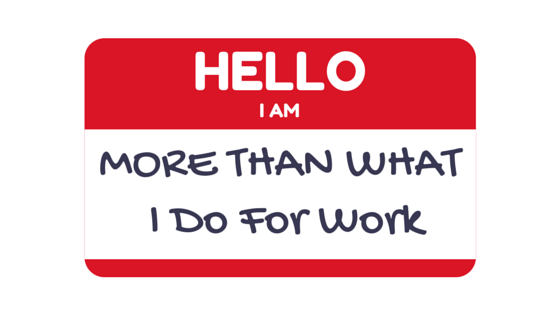
Living equals working when make strangers talk for the first time.

American “man code” deems it acceptable to learn of a stranger’s occupation before anything else. (I can’t speak for women in this scenario, but feel free to comment below if it resonates with you as well.)

Of course, you have the option of hiding behind your phone and checking his or her Linkedin profile to see if his job is even worth talking about. This strategy works well if you fear the conversational unknown.

In a professional setting it makes sense to talk about work, but why can’t we put work away when we have the chance to talk about other things?

Five Reasons Why You Limit Conversation with Strangers to Your Work

I can think of four “good” reasons why we would begin an ambiguous social situation by asking “What do you do?”: 

1) In the Age of the Short Attention Span, it makes sense to get immediate feedback on whether this person is worth your time investment. Also, with all of our messaging, video conferencing, emailing, Tweeting, and Facebooking, we’re gradually forgetting how to relate to people in the flesh.

2) You ask about his so you can talk about yours. Talking about your occupation would be intensely satisfying if you’re proud of a recent work victory or a change in your professional identity.

3) You have no idea what to talk about other than what you do for a living. You have few hobbies or interests. Life is work for you.

4) You’ve been conditioned to ask this question. The thought of discussing your private life with a relative stranger is anxiety-provoking.

5) You suffer from social anxiety, which limits your mental freedom to talk about risky and personal topics.

A conversation with an unfamiliar person can be steered in many directions, yet it’s as though there’s some strange, magnetic, American pull toward the topic of work as quickly as possible.

Yes, it’s absolutely normal to feel nervous and uncomfortable when you’re expected to create conversation with someone new for more than a few moments. Discussing work makes total sense since we all expect it, but does that make it a good choice?

The Price of Starting a Conversation by Exchanging Occupations

Americans pay a heavy price for requiring passage through unnecessary and meaningless social niceties in order to get to the good stuff.  

Unless you’re passionate about your job and you’ve established some semblance of a “work-life balance” (an unattainable, silly ideal for most of us), it’s not so healthy to avoid sharing more about yourself with someone new.

This habit is usually a sign that you haven’t properly invested in finding and carrying out your passions.

If you’re passionate about non-work activities, you’ll want to talk about them. If you lack passions in your life, then work is a safe topic.

Take a moment to consider how much you tend to discuss work in ambiguous social situations. If you are a what-do-you-do-for-work kind of person, then it’s a sign you need to invest more time in things that make you happy.

The Challenge of Social Anxiety

Many of us struggle with social anxiety. We enter a room filled with unfamiliar people and our thoughts begin to race. We wonder how we’re being judged by others. We have very specific fears about the worst judgments someone can make.

Social anxiety seems to be an even larger issue among younger generations who’ve been raised on screens and who prefer texting over face-to-face communication.

A quick tip for people grappling with social anxiety: 

Enter an ambiguous social situation prepared with in-depth knowledge of one or two topics you feel comfortable talking about. Reading the New York Times, Time Magazine or some other news source that explores issues on a deeper level. This way you can always steer the conversation toward one of your comfortable topics if you’re super nervous. Ideally, you will choose topics you’re passionate about.

It’s much easier to talk about our passions. Challenge yourself to avoid discussing your job. This will help you to value your passions more. Try to get at what your conversation partner is passionate about. Avoid asking about his or her job.

If the person you just met keeps talking about his or her job, allow him or her to talk about work for a bit and then try to steer the conversation toward what you’re both passionate about in life. Let him or her speak as much as you do.

I promise you you’ll get more out of the conversation.

An American Phenomenon

Why do I label this social behavior as an American issue?

Americans seem to work more than people from most other countries. It’s how we spend most of our time, so we define ourselves by what we do for a living.

In order to maintain our consumer-driven culture, we have to work long hours to afford stuffing our lives with material goods.

Feel free to comment below if you agree or disagree.

January 2, 2016 0 comments
0 FacebookTwitterPinterestEmail
Newer Posts
Older Posts

Inside Your Personal Digital World

  • What Your Posting Style on Social Media Says About You

    April 21, 2019
  • A Secret Door to Happiness is Written on Your Wall

    October 2, 2015
  • The Real Reasons You’re Stingy with Your Facebook Happy Birthday Wishes

    July 3, 2015

Copyright 2025.  We are dedicated to protecting the privacy of our readers.


Techealthiest | The Technology of Mental Health
  • Mental Change Tech
    • Happiness
      • Habit Shifter
      • Smartest Future
    • Stress
      • Human-Phone Bond
  • Parent Thing
  • Social Media Lama
    • Love Optimizer
    • App Dating
    • Healthy Selfie
    • Healthify Facebook
    • Enlightened Upgrading
  • Narcissist Mgmt
  • Phone Love
  • Covid
    • The Bright Side
  • About
    • About Techealthiest
    • About Dr. Greg
    • The Techealthiest Mission
    • Privacy Policy
    • Terms of Use
    • Contact
Techealthiest | The Technology of Mental Health
  • Mental Change Tech
    • Happiness
      • Habit Shifter
      • Smartest Future
    • Stress
      • Human-Phone Bond
  • Parent Thing
  • Social Media Lama
    • Love Optimizer
    • App Dating
    • Healthy Selfie
    • Healthify Facebook
    • Enlightened Upgrading
  • Narcissist Mgmt
  • Phone Love
  • Covid
    • The Bright Side
  • About
    • About Techealthiest
    • About Dr. Greg
    • The Techealthiest Mission
    • Privacy Policy
    • Terms of Use
    • Contact
@2021 - All Right Reserved. Designed and Developed by PenciDesign